
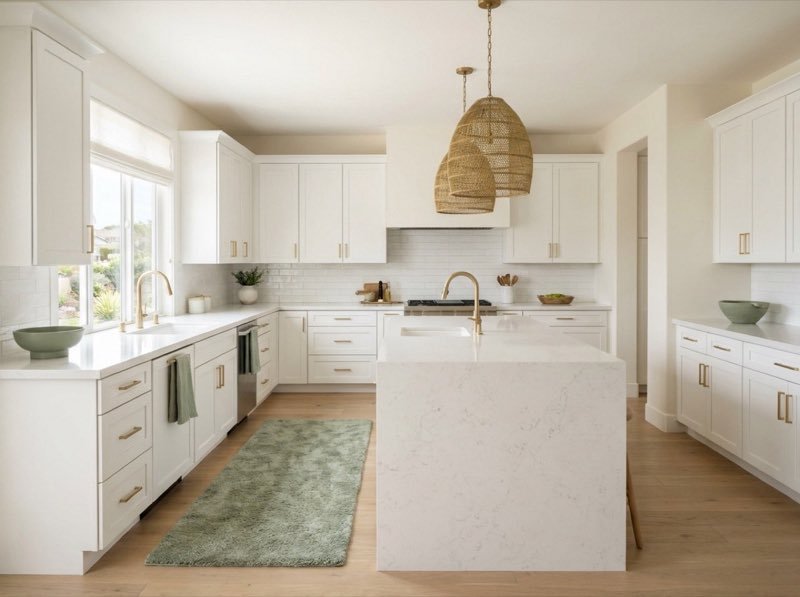
How much does a kitchen remodel cost in San Diego?
Realistic 2026 price tiers, where the budget actually goes, and an honest look at resale value.
See the cost breakdown
The Journal · Updated June 12, 2026
Few projects change what a property can do quite like an accessory dwelling unit. An ADU — granny flat, backyard home, in-law suite — can house aging parents, give adult children a real foothold, generate rental income, or simply add flexible square footage to a lot you already own.
It can also be confusing, because San Diego’s ADU rules shifted significantly in 2025. Plenty of articles still ranking on Google describe a bonus program that no longer works the way it did. This guide reflects the rules as they stand in mid-2026, along with the practical lessons that haven’t changed: how to budget, how to design a unit people genuinely want to live in, and how to think about rent.
San Diego recognizes a few distinct ADU types, and the one you choose shapes both your budget and your permitting path.
From 2020 to 2025, San Diego ran one of the most generous “bonus ADU” programs in California. In many zones, homeowners who deed-restricted one unit as affordable could add additional market-rate units — near transit, sometimes with no fixed cap at all. In mid-2025 the City Council voted to roll much of that back, and the revised rules took effect in August 2025.
The headline changes:
The rollback did not touch the state-law baseline, which is what the large majority of homeowners actually use. On virtually any single-family lot in San Diego you can still add:
Just as important, this baseline path is ministerial: no public hearing, no discretionary approval, and a 60-day decision clock once your application is complete. Two caveats remain. Coastal-zone properties — think La Jolla, Del Mar, Point Loma — may need a Coastal Development Permit, and setback, height, and lot-coverage limits still vary by zone. The rules also keep evolving, which is why a feasibility review of your specific parcel should come before any design work begins.
In 2026, most quality ADUs in San Diego land between $150,000 and $400,000+, depending on type, size, and finish level. Garage conversions sit at the lower end; fully detached, custom-built units with premium finishes reach the top.
Treat these as planning ranges, not quotes. Lot conditions, utility runs, and finish level move the number meaningfully — every project is scoped individually.
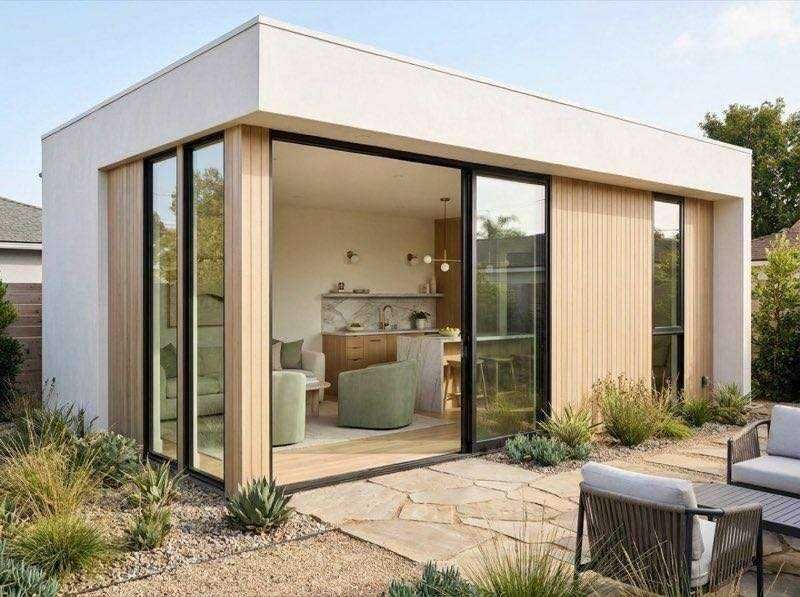
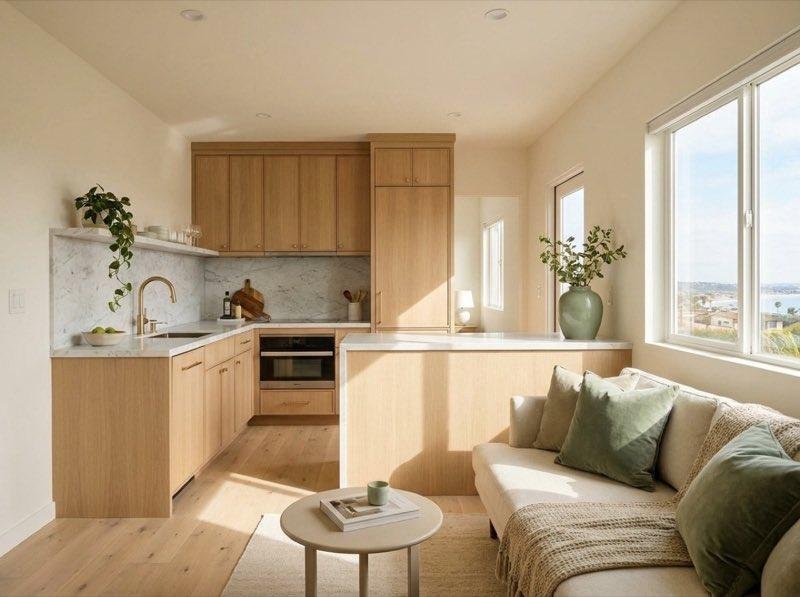
The best ADUs feel like real homes, not afterthoughts. Smart space planning, abundant natural light, and quality finishes make a small footprint live much larger — and earn stronger rent. Full-height windows, an efficient kitchen, generous storage, and a private entry sequence do more for daily life than any extra square foot. Where the lot allows, a small patio or landscaped approach gives the unit its own outdoor living moment instead of a leftover corner of yard.
Matching the ADU’s architecture to your main home matters too. A unit that looks like it belongs protects curb appeal — and the value of both structures.
San Diego rents are strong, but no article can tell you what your ADU will earn — it varies by size and location more than anything else. A studio in an inland neighborhood and a two-bedroom near the coast sit in completely different markets. Before you build a budget around rent, pull current listings for comparable units near your address and price against those, not against a countywide average.
Two principles hold everywhere: a thoughtfully designed unit consistently out-earns a basic one, and if you pursue the bonus program, a deed-restricted affordable unit caps what that unit can charge — run the numbers both ways before committing.
An ADU is a complete small home — foundation, structure, utilities, kitchen, bath. The smoothest projects keep design and construction under one roof, with feasibility, drawings, engineering, permits, and the build itself carried by one accountable team rather than handed between vendors. That is how our ADU design-build service runs, from the first parcel review to the final walkthrough.
And if what you really need is connected space — a larger kitchen, a primary suite — compare the ADU against a room addition before you commit. They solve different problems.
For many San Diego homeowners, yes — with clear eyes. An ADU adds usable space and long-term property value, creates rental potential, and gives a family options as needs change. The 2025 rollback narrowed what large multi-unit projects can do, but it left the single-ADU path — the one most homeowners want — fully intact. Plan around the current rules, budget with honest ranges, and design something worth living in.
Keep reading
Realistic 2026 price tiers, where the budget actually goes, and an honest look at resale value.
See the cost breakdown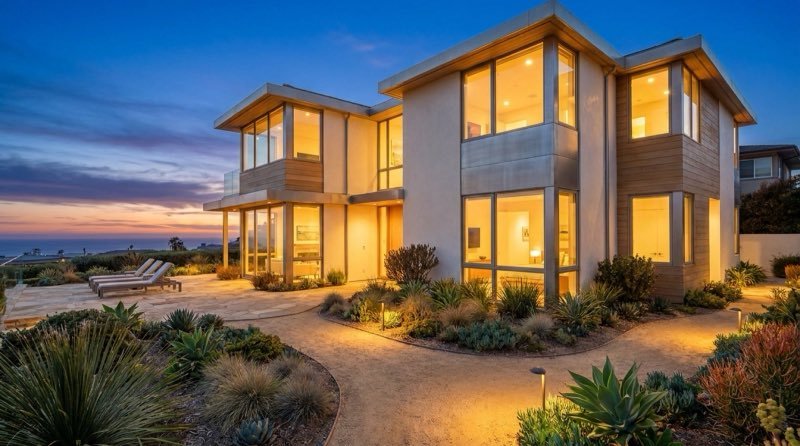
The finishes, metals, and woods that hold up to salt air — and the ones that quietly fail.
Browse the materials guideFree estimate
Tell us about your property. We’ll follow up to schedule a free consultation — a real conversation about your lot, what the current rules allow, and what it takes to build a unit worth living in.
9920 Pacific Heights Blvd, Suite 104
San Diego, CA 92121 · By appointment
Share a few details and we’ll be in touch shortly.
Begin the journey
One team from parcel review to keys — clear scope, organized jobsite.